Drug Discovery & Early Research
From target identification to lead optimization, early research data is scattered by design. Screening data, omics results, and safety assays sit apart from the public and commercial knowledge that gives them context, and the same gene or compound is often labeled differently in each.
DISQOVER connects it into a single, searchable knowledge layer, so research teams and their AI systems work with concepts, not source-specific labels.
The data you already have
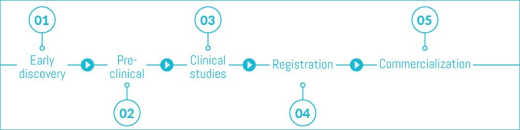
Early drug discovery is a broad domain with two main segments: target identification and validation, and hit identification and lead optimization. In both, data integration means connecting internal, public, and commercial data into one place a research team can query, without migrating or restructuring the source systems themselves.
You do not need new data to get value from DISQOVER: computational biologists, drug discovery R&D teams, and pharmacologists already work with a recognizable set of public, proprietary, and licensed sources, and DISQOVER connects them.
Including licensed but free sources
How it works
DISQOVER resolves two problems at once: differences in terminology across systems, and the relationships between concepts that span domains, adding the traceability a target decision needs on top.
Outcomes
In early research, speed isn't the only goal.
Each target that moves forward commits budget and time to the stages that follow, so what matters most is having the full evidence behind the decision. DISQOVER connects your internal target and assay data with public life sciences knowledge, so your team decides with the whole picture in view, not just the part that was easy to collect.
Today, trials, patents, and pipelines are checked in separate tools, often after work on a target has started, so crowded targets are found late. With all three linked to the target, teams see who else is pursuing it, and which patents cite it, before committing resources. The return is less investment in programs with little room to differentiate.
Clinical trials, patents, and your licensed pipeline data are connected to the same targets, diseases, and compounds as the scientific evidence, so a landscape check starts from the target itself.
Today, comparing targets means assembling evidence by hand from separate databases, so targets with thin genetic or pathway support can reach validation before the gaps show. With public, licensed, and internal evidence side by side, researchers rank targets up front, and review committees decide on evidence they can trace and defend. The return is less validation and screening effort spent on targets that don't hold up.
Open Targets, UniProt, GWAS Catalog, Reactome, and STRING come pre-harmonized and link to your own target data. Every finding traces back to its source and version.
Before a target enters a screening campaign, teams see connected internal assay results next to published pathway and genetic evidence. The return is that the organization does not pay twice for assays it has already run.
Past results are connected to the target rather than buried in project folders, so nobody has to rely on who remembers the earlier work.
The same harmonized data carries forward into translational and clinical work, so the evidence gathered for a target isn't rebuilt at the next stage.
Customer story
Target assessment depends on pulling together disease-relevant data to evaluate whether a target is druggable and likely to work with minimal side effects. This customer's process involved manual data handling and disjointed workflows, creating bottlenecks in early discovery. They built a FAIR-compliant data lake for target assessment with DISQOVER at its foundation, unifying internal, licensed, and public target data into one structured, harmonized repository.

DISQOVER supports natural language search directly in DISQOVER Explore, and through its MCP interface, AI agents and LLM applications can query the same knowledge layer in natural language, getting grounded, provenance-backed answers back either way.
DISQOVER ships with industry-standard ontologies and domain-specific entity models out of the box, so drug discovery concepts are understood from day one, without months of configuration. For drug discovery and early research, that includes:
DISQOVER's data ingestion engine manages the import, transformation, and integration of every data source in one place, through a graphical interface that does not require specialized IT skills.
Ontologies, cross-references, contextual information, and named entity mapping harmonize the data as it comes in, so internal target data is automatically linked to public and licensed sources, without manual literature review to make the connection.
DISQOVER tracks which sources contributed to every data point, so visibility can be restricted by user group without separate access-management tooling, consistent across the UI and the API.
This matters when internal screening data and licensed chemistry databases sit in the same knowledge layer but carry different access rights.
FAQ
Drug discovery data integration brings your internal screening, omics, and target data together with public and commercial knowledge sources, so research teams can query across all of it from one place. DISQOVER ingests your data without changing your source systems and links it in a knowledge graph. In practice, a gene identified in an internal assay can be linked directly to its known pathways, associated diseases, and existing compounds.
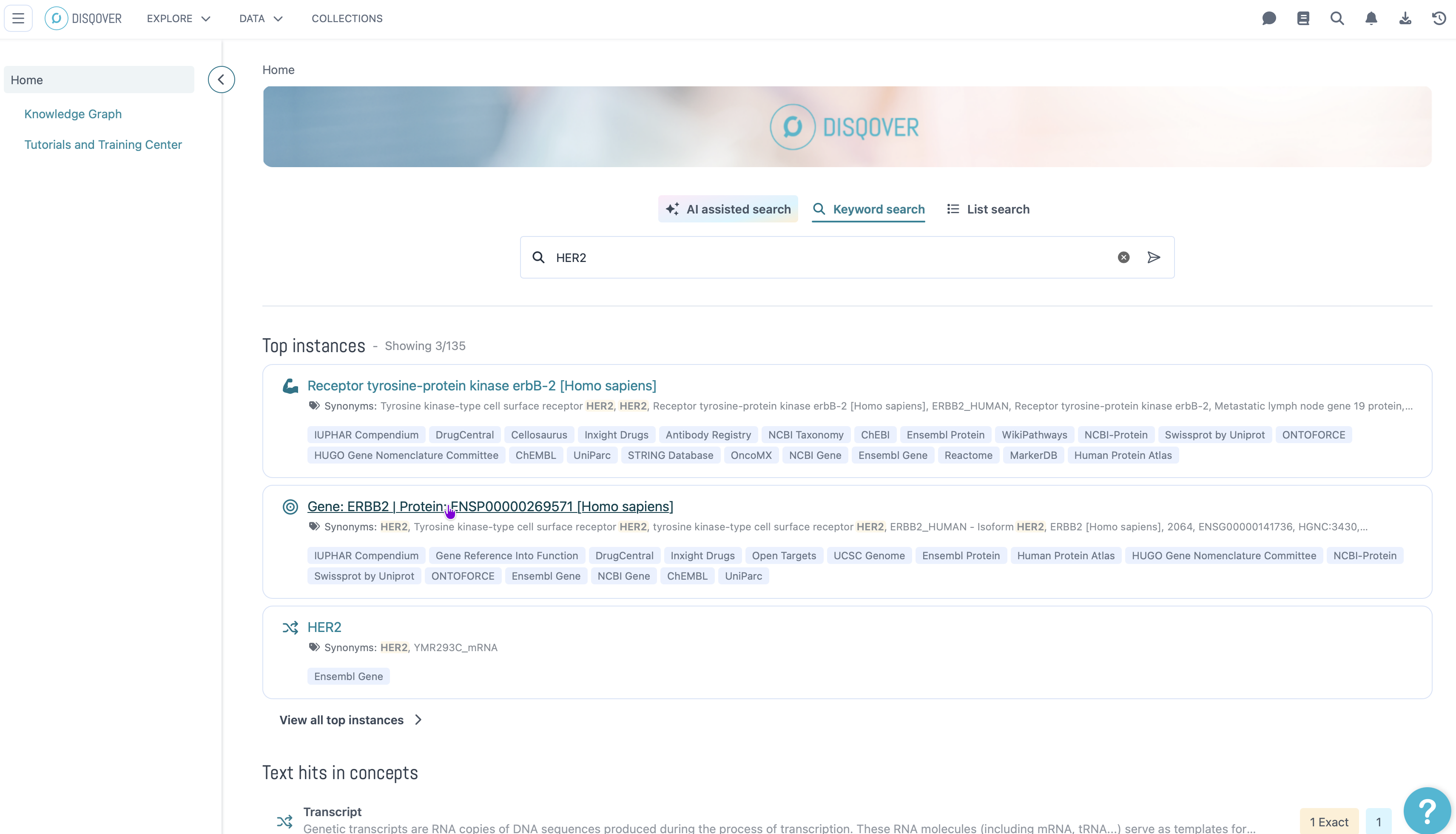
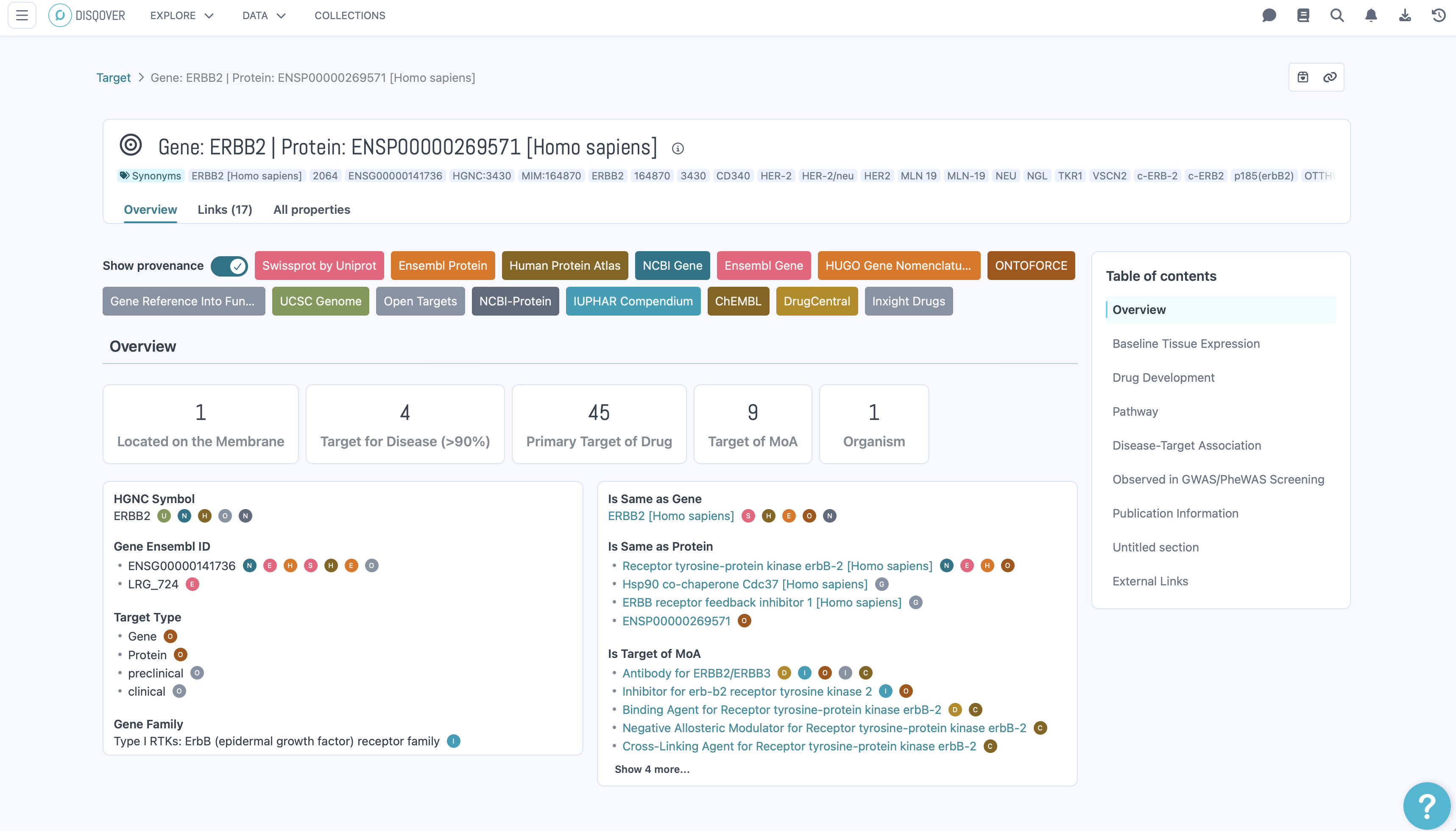
Thanks to pre-harmonized Data Packages and DISQOVER's modeling capabilities, synonyms are recognized across sources, so EGFR, ErbB1, and HER1 resolve to the same concept. Searches also expand through concept hierarchies: a search for "neoplasm" includes "carcinoma" and "lymphoma." Scientists and AI agents get complete results whichever naming convention a source used.
Yes. DISQOVER ingests proprietary data such as high-throughput screening results and internal target repositories, and links it to public sources like Open Targets, UniProt, and ChEMBL, which ONTOFORCE pre-integrates and refreshes monthly as Data Packages. A researcher can move from an internal hit to published target and pathway evidence in the same session, with provenance preserved.
Through DISQOVER's MCP server, AI agents and LLM applications such as Claude, ChatGPT, or a custom-made enterprise agent can query DISQOVER in plain language. Answers come from your DISQOVER data, respect each user's access rights, and include a link that reopens the exact result set, so scientists can verify what the agent worked from.
No. Scientists explore data through DISQOVER Explore, using semantic search and interactive visualizations. They can also ask questions in plain English through an AI tool connected to DISQOVER's MCP server. No query language is needed.
Every result links back to its source, version, and context. For AI queries, each answer includes a link that reopens the exact result set in DISQOVER. Search uses fixed, curated synonym rules rather than probabilistic matching, so the same query on the same data returns the same results.
Yes. The REST API and Python library give programmatic access. Harmonized data can be exported in Parquet, RDF, JSON, CSV, and other formats for ML pipelines, data lakes, and BI tools.
No. DISQOVER connects and harmonizes data from sources like Open Targets and ChEMBL alongside internal data; it does not replace them. The value is in linking proprietary research to that public and commercial context in one searchable layer, rather than requiring teams to move between disconnected tools.
Related resources
Panel discussion
The evolving AI landscape in life sciences in 2026: AI-ready data, agents, and semantic technologies

Testimonial
Transforming Merck’s data culture: leveraging ONTOFORCE’s DISQOVER for unified data access

Blog
Gartner’s 2026 predictions confirm: the semantic layer is no longer optional
Talk to us about connecting your screening data, omics results, and public target evidence into one searchable knowledge layer.
ONTOFORCE enables life science companies to unlock hidden insights from data.
With DISQOVER, built on knowledge graph technology, we support life sciences and pharmaceutical companies with innovative data management and visualization.