

BLOG

With the October 2026 release, DISQOVER MCP graduates from beta to a fully supported part of the DISQOVER platform. It gets there because a group of pharma and biotech teams used it on real work, told us what broke, and helped us shape what it became.
DISQOVER MCP is a governed interface that lets AI assistants and agents work directly with your DISQOVER knowledge graph. Ask a research question in plain language, in the AI client you already use, and get an answer grounded in your data, with a link back into DISQOVER to see the evidence for yourself.
This post is the story of how it got here: what we launched, what we heard, and what we changed.
Our customers' scientists were already turning to AI assistants for research questions, but those assistants could not see the knowledge graph their organization had built in DISQOVER. That left a gap: general AI answers on one side, curated and governed data on the other, and people copying between the two.
At the same time, every organization was choosing its own AI stack. Building a separate integration for each assistant would never keep up. We wanted one open, governed interface that any MCP-compatible assistant or agent could use.
A scientist asks a question in plain language, in the AI tool they already use, and gets an answer grounded in their DISQOVER data. Every answer links back into DISQOVER, so they can check the evidence and keep exploring. And the organization stays in control of what the AI can see.
The value for customers
We shipped the first version of DISQOVER MCP in May through our MCP Beta Access Program. We chose to put it in customers' hands early rather than polish it behind closed doors, because an AI interface only proves itself against real questions, real data, and real workflows.
The beta had a clear goal: learn how people actually use it. We wanted to see which questions scientists asked, which AI clients they connected, where setup got stuck, and where the answers fell short. MCP is an open standard, so customers could bring whatever assistant, chat or agent their teams already relied on.
The feedback was direct, and it clustered around four themes:
Each of these became a workstream for us to work on.
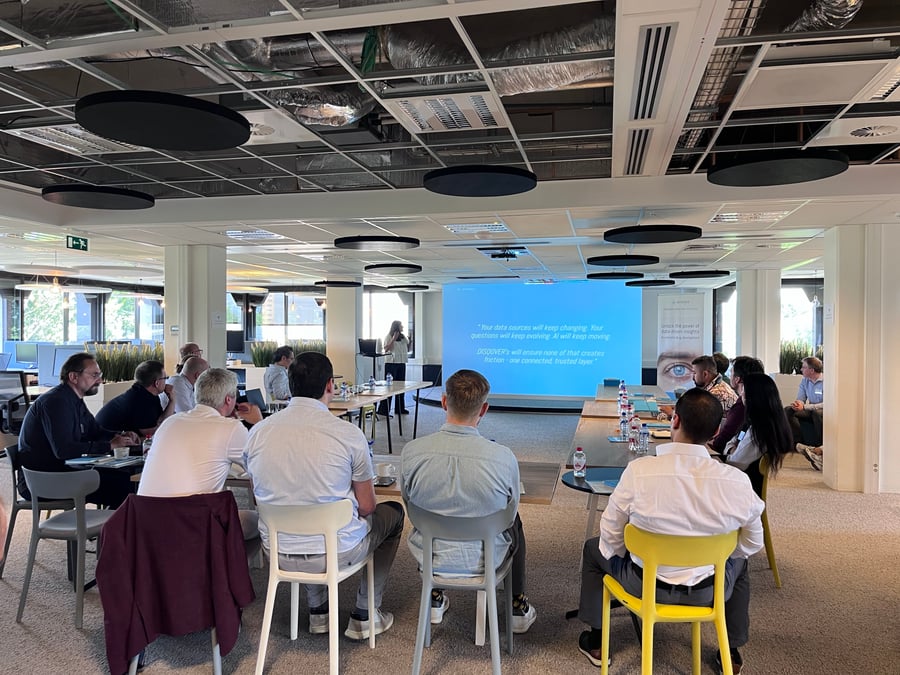
Presenting the freshly launched DISQOVER MCP and our vision for AI-ready data at ONTOFORCE's client event in June 2026.
Over the summer releases we worked through that feedback one theme at a time. The early work made the beta reliable enough to use unsupervised; the later work made it efficient and consistent enough to scale.
We reworked how DISQOVER MCP is deployed and connected, so teams can get up and running without a support call. We also extended automated testing across the full authentication flow, so every release is checked end to end before it reaches our customers.
We trimmed what DISQOVER MCP sends back to the assistant: smaller, leaner responses that carry what the model needs and nothing more. The result is lower token cost per session, and faster answers along the way. Complex searches can also be captured as a compact, shareable link instead of a long query string.
We standardized our tool descriptions so assistants reason about DISQOVER data the same way, whichever client they run in. We fixed incorrect query generation, made mid-task check-ins with the user work reliably, and added support for filtering on several values in a single search instead of one query at a time.
Skills are the instructions that teach an agent how to work with DISQOVER well: how to discover what data is available, build a query step by step, and hand back a result you can open. We iterated on them repeatedly using real sessions from the beta program, adding guidance for edge cases where agents used to stall, such as protected data types that should be answered in aggregate rather than row by row.
The October release makes DISQOVER MCP an official, supported product. For customers, that means three things:
In this short demo video, a researcher asks an AI assistant a feasibility question: how many Phase 3 breast cancer trials like theirs are open or in follow-up? The assistant is connected to DISQOVER through MCP. Its answer comes with a link that opens the exact query in DISQOVER, every filter visible. From there they narrow the results with interactive charts and generate a feasibility report in minutes.
Productizing is a milestone, not a finish line. Next on our roadmap: letting assistants build real DISQOVER outputs such as tables, charts and saved explorations, not just answer questions; working across multiple spaces and data graphs in one connection; and a chat experience inside DISQOVER itself, powered by the same MCP.
To every customer who joined the beta program and tested, broke, and questioned DISQOVER MCP: thank you. You shaped this product.
ONTOFORCE enables life science companies to unlock hidden insights from data.
With DISQOVER, built on knowledge graph technology, we support life sciences and pharmaceutical companies with innovative data management and visualization.