Life sciences organizations have spent years integrating data, and most still hit the same two walls: a language problem (a gene called EGFR in one system and ErbB1 in another) and a relationship problem (a target-to-disease connection that exists only in a report nobody can query). Conventional integration approaches don't address either one, regardless of how much effort a team puts in.
What is the language problem in life sciences data?
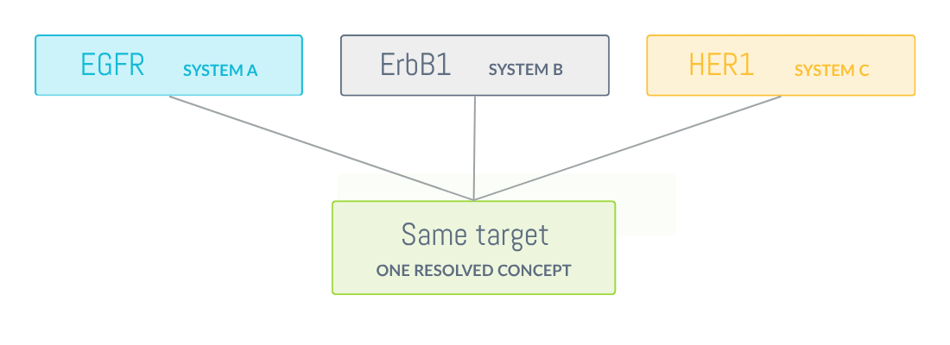
One system records “EGFR.” Another says “ErbB1.” A third says “HER1.” All three refer to the same target, but nothing in a standard database tells you that. Disease classifications vary between ICD-10, MedDRA, and internal terminologies. Compound identifiers differ between chemistry databases, clinical systems, and patent filings. Multiple valid naming conventions coexist in life sciences by design, the product of decades of independent research groups, vendors, and regulatory bodies working in parallel, not a sign of sloppy data management.
Semantics is the branch of linguistics and logic concerned with meaning: how words, phrases, and symbols convey concepts in context. Semantic technology applies that same idea to machines, giving them tools, standards, and methods to interpret the meaning of data rather than just store it. In life sciences, this typically runs through an ontology: a formal representation of the concepts in a domain and how they relate to each other, used to reason about that domain and to let computers and humans share and reuse the same knowledge consistently.
Life sciences already has a strong tradition of these standards. Gene Ontology, Sequence Ontology, and the Medical Subject Headings (MeSH) vocabulary all exist for the same reason: to keep terminology consistent enough that content can be indexed and retrieved reliably, whatever label an individual source happens to use. An ontology is what lets a system resolve EGFR, ErbB1, and HER1 to a single concept automatically, rather than relying on a person maintaining a mapping table by hand.
What is the relationship problem in life sciences data?
The second property is separate from naming, and just as consequential. A gene relates to a pathway. That pathway relates to a disease. That disease relates to a compound, and that compound to an adverse event. These relationships cross domains, systems, and organizational boundaries, and answering “show me the connection” is one of the most common and valuable questions in life sciences research. Relational databases and data warehouses can store this kind of information, but storing a relationship and being able to follow it are two different things. You have the data. You don't have the connection.
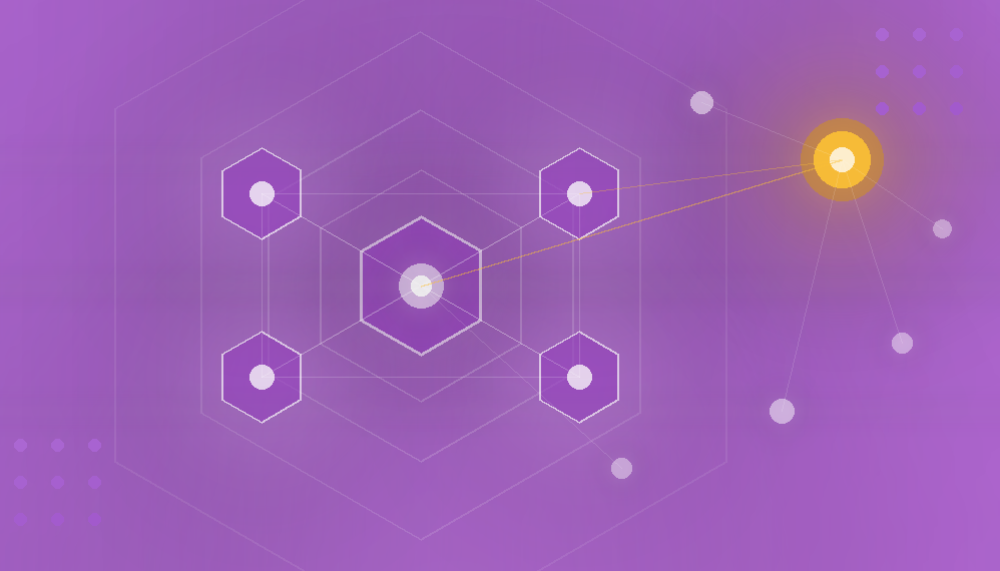
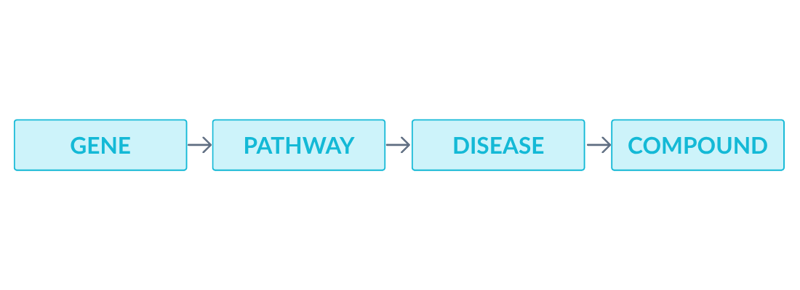 A knowledge graph addresses this directly. It consolidates data from multiple sources into nodes, the key entities in a domain such as genes, compounds, diseases, or organizations, and connects them through edges that represent real relationships: a drug-target interaction, a clinical study linked to its sponsor, a gene linked to the pathway it participates in. The structure itself is the point. Once relationships are modeled explicitly, they can be followed, not just retrieved.
A knowledge graph depends on an ontology to do this well. The ontology defines what types of entities exist in the domain and how they're allowed to relate; the knowledge graph is where that structure gets populated with actual data and made queryable. In a life sciences knowledge graph, an ontology might define how diseases, symptoms, treatments, and patient demographics relate to one another, which is what makes a sophisticated cross-domain query possible in the first place, rather than something assembled manually from half a dozen disconnected sources.
Why does this matter for AI in life sciences?
Every AI system built on top of life sciences data inherits both problems. A model asked to reason across “EGFR” and “HER1” data will treat them as unrelated unless something has already resolved the language problem upstream. An agent asked to trace a gene to a downstream adverse event can only follow a path that has actually been modeled as a graph; it can't infer a connection that only exists in a person's head or a slide deck.
Grounding has to happen before retrieval, not after.
Data warehouses solve structure. Search engines solve retrieval. Neither solves the combination of semantic fragmentation and cross-domain relationships that defines this specific challenge. That's the space a semantic layer and a knowledge graph occupy together, and it's the foundation DISQOVER is built on: a knowledge graph populated through semantic mediation, so that researchers, AI agents, and API consumers can work with concepts like targets, compounds, and diseases directly, instead of first having to know how each source happened to structure or label its data.
The takeaway
The instinct is to treat life sciences data integration as a volume problem, something more storage or more pipelines eventually solves. It isn't. The harder problem is that the same concept has many names, and the connections between concepts live across systems that were never designed to talk to each other. Solving both is what separates data that's merely integrated from data that's actually usable, by people and by the AI systems increasingly built on top of it.