

BLOG
Before an autonomous AI agent can be trusted in a drug discovery pipeline, three conditions have to be met:
Until those hold, agents belong in the pipeline as copilots, not as autonomous decision-makers.
The vision is easy to describe and hard to deliver. Instead of an AI assistant that answers a question when asked, imagine an AI agent that works alongside a scientist as a colleague: reasoning across compound libraries, prior experiments, and the literature, proposing targets, and doing the cognitive grunt work that today consumes a researcher's week. Some call it the "virtual researcher." Google frames its own version as a "co-scientist," a multi-agent system, built with Gemini, that generates, debates, and refines novel scientific hypotheses; its foundational research was published in Nature in May 2026, and it is being rolled out to researchers through a tool called Hypothesis Generation. Notably, even this leading example is positioned as a collaborative partner that proposes hypotheses for a scientist to test, not an autonomous system that decides on its own. The partner/assistant idea is compelling enough that some life sciences organizations are already experimenting in some way toward it.
But there is a question underneath the excitement that the industry has been slow to answer. When a human researcher surfaces a finding, you can ask them how they got there, what they looked at, and whether they can reproduce it. There is accountability, and you can challenge the reasoning. When an agent surfaces a conclusion, who signs off on it? In a regulated industry, that is not meant to be an open-ended philosophical aside. The answer determines whether or not you have a system you can deploy. This post works through the three conditions that have to be true before you can trust an autonomous agent in a pipeline, and what to do in the meantime.
Trusting an agent is harder than trusting a single model output because an agent chains many steps together, and the errors compound. A one-shot model answer can be checked in isolation. An agent decomposes a question, retrieves from multiple sources, reasons across them, and acts, often over several steps, each of which can introduce an error that the next step inherits. By the end, a small ambiguity early on can become a confidently wrong conclusion.
That compounding is made worse by a well-known tendency of large language models: they abhor a vacuum. Ask a question with insufficient grounding and a model will still produce an answer, fluent and confident, filling the gap rather than flagging it. In casual use that is a nuisance. It becomes a liability in a drug discovery pipeline, where a conclusion may inform which target a team pursues for the next year.
This means a demo can look extraordinary and still be nowhere near deployable. Getting an agentic workflow to roughly the right answer most of the time is achievable quickly. Closing the distance from there to the reliability a regulated pipeline demands is where the real engineering lives, and it is exactly where the three conditions below come in.
Traceability means every reasoning step, every data source consulted, and every decision point is logged and queryable, by design rather than as an afterthought. If an agent proposes a target, you need to be able to reconstruct exactly how it got there: which datasets it drew on, which relationships it followed, and where each intermediate conclusion came from. A human researcher keeps notes and can walk you through their reasoning. An agent has to do the same, in a form a machine and a reviewer can both follow.
This is where a distinction that is often blurred becomes important: provenance and lineage are not the same thing. Provenance is about origin, where a piece of data came from, who created it, when, and under what conditions. Lineage is about journey, what transformations were applied after creation, which systems the data passed through, and what decisions were made along the way. When an agent synthesizes an answer from many sources, a regulator will want both: not just where the data originated, but the full chain from raw source to final conclusion, without gaps.
The difficult thing is that most agentic systems being built today cannot produce that chain. The reasoning happens inside the model and is not logged in any auditable way. Traceability that is bolted on after the fact tends to be incomplete, which just doesn’t play from a regulatory perspective.
Reproducibility means that running the same workflow again over the same data returns the same result, or that you can explain, precisely and explicitly, why it did not. In a regulated industry this is the baseline for any result that informs a decision.
The difficulty is that language models are probabilistic by nature. The same prompt can yield different outputs across runs, which is tolerable for brainstorming and unacceptable for a step in a validated pipeline. So reproducibility becomes an engineering goal rather than an assumed property: identifying where variation is acceptable and where it is not, and constraining the latter.
There is a legitimate source of variation worth separating from the rest. If an agent returns a different answer because the underlying data changed between runs, that is explainable and defensible, and a good system will surface it. What is not defensible is variation with no accountable cause, an output that differs because the model happened to wander down a different path. Distinguishing the two is part of what makes a workflow trustworthy, and it depends on the traceability described above.
In this case, trustworthiness is not a feeling. It is earned incrementally, by validating individual steps, replacing probabilistic reasoning with deterministic code wherever a step allows it, and building a track record over time. In a regulated setting, "the model was confident" will not satisfy a reviewer, and confidence is in any case a poor proxy for correctness.
In practice this means engineering agentic workflows back toward determinism step by step. Language models are excellent for prototyping a workflow and for the genuinely open-ended parts of a problem. But wherever a step can be handled by deterministic logic or checked by a second process, that is usually where it should go, because it removes a source of unaccountable variation and makes the whole chain easier to validate. One pattern that works well is verification by a separate process: an agent's output, along with the references it cites, is checked against those sources before it is accepted. It does not guarantee perfection, but it measurably raises trust in the result.
Demonstrable trustworthiness also depends on observability at the level of the agent, not just the data. Standard data observability, lineage and pipeline health, is already thin in many organizations. Agentic observability has to go further, producing the documentation and controls that show an agent is genuinely bound by a responsible AI framework, not merely assumed to be well-behaved.
The pragmatic answer is to deploy agents as copilots with a human in the loop, and to build the data and observability foundations that fuller autonomy will require. Framed simply: AI suggests, and humans decide. First-generation scientific agents work well as assistants that accelerate real tasks, literature synthesis, evidence gathering, drafting, while a scientist retains the decision. Fully autonomous "self-driving" workflows are realistic only for tightly defined tasks such as screening, not for the open-ended judgment that most science requires.
Underneath that, the enabling work is the semantic and infrastructure layer that makes traceability and reproducibility possible in the first place. An agent can only produce a clean provenance and lineage trail if the data it reasons over carries meaning, relationships, and origin in a machine-readable form. This is the role of a semantic layer, a layer of meaning over raw data that captures definitions, relationships, and context, and of a knowledge graph, a structure that represents entities and the links between them so that reasoning can be followed and audited.
This is where DISQOVER, ONTOFORCE's AI-ready semantic data platform for life sciences, fits the trust problem. By connecting fragmented research, clinical, and regulatory data into a unified view built on a knowledge graph, it gives agents data that carries its own context and provenance, the raw material traceability and reproducibility depend on. The point is not that a platform makes an agent trustworthy on its own. It is that trustworthiness is impossible without a data foundation that can account for itself, and that foundation is what a semantic layer provides.
Trust in an autonomous agent is not granted because the output is impressive. It is earned when the system can show its work, repeat it, and prove it stayed within bounds. That reframes the near-term goal for most teams: not chasing full autonomy, but building the traceability, reproducibility, and observability that would make autonomy defensible if and when it arrives. Agents in a drug discovery pipeline are, for now, best understood as brilliant but unproven colleagues. You can give them real work, but you still check their homework.
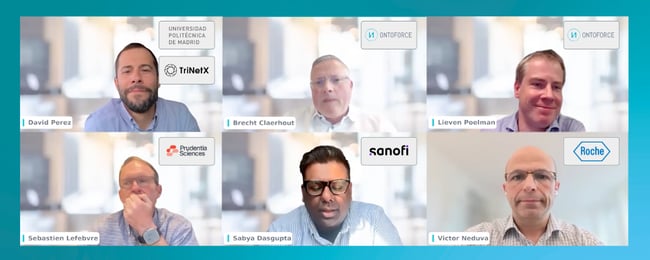
These three conditions were among the themes explored in a recent ONTOFORCE panel on the evolving AI landscape in life sciences, featuring data and AI leaders from Sanofi and Roche, ONTOFORCE, and other experts.
The full discussion goes deeper on agentic AI, the data foundation it depends on, and the governance questions that decide what gets deployed.
Can you trust AI agents in drug discovery today? Not for autonomous decisions. Current first-generation scientific agents are best used as copilots that accelerate specific tasks while a human scientist retains the decision. Trusting an agent to act autonomously in a regulated pipeline requires traceability, reproducibility, and demonstrable trustworthiness, which most systems being built today cannot yet provide.
What is a "virtual researcher?" It is the idea of an AI agent that works alongside a scientist as a colleague rather than a tool, combining the speed and breadth of an agent with the judgment of a human researcher. It is an aspiration the industry is working toward, not a deployed reality, and the gap is largely a matter of trust and accountability rather than raw capability.
What is the difference between provenance and lineage? Provenance is about origin: where data came from, who created it, when, and under what conditions. Lineage is about journey: what transformations were applied, which systems the data passed through, and what decisions were made along the way. A regulated agentic system needs both to reconstruct the full chain from raw source to final conclusion.
Why do AI agents hallucinate in scientific workflows? Large language models tend to produce a fluent, confident answer even when grounding is insufficient, filling gaps rather than flagging them. In an agentic workflow that chains many steps, an early unflagged gap can compound into a confidently wrong conclusion, which is why grounding and validation matter more as autonomy increases.
What does human-in-the-loop mean for agentic AI? It means the agent suggests, retrieves, and reasons, but a human makes the final decision and remains accountable for it. This is the appropriate model for first-generation scientific agents and will remain so until the infrastructure for traceability, reproducibility, and agentic observability is mature enough to support fuller autonomy.
How does a semantic layer help make AI agents trustworthy? A semantic layer and knowledge graph give data machine-readable meaning, relationships, and provenance. That is what lets an agent produce an auditable provenance and lineage trail and reason over data reliably. Without a data foundation that can account for itself, traceability and reproducibility are not achievable, so trustworthiness is not either.
Last updated: August 2026
ONTOFORCE enables life science companies to unlock hidden insights from data.
With DISQOVER, built on knowledge graph technology, we support life sciences and pharmaceutical companies with innovative data management and visualization.